

Market Vendors
Every market is a different county.
Every county is a different permit.
Each market the booth works is its own TFE permit, its own COI rider, and its own inspector. CredentiAlert tracks every one of them in one dashboard and alerts you before any of them lapse, so the 6am gate is never the place you find out.
No credit card required to get started.
The jurisdiction matrix
8 markets.
6 jurisdictions.
What a typical multi-market vendor carries on the booth each week.
A vendor working multiple farmers markets routinely holds six or more active Temporary Food Establishment permits at once. Each from a different city or county health department. Each on its own renewal calendar. Each with its own inspector. The market manager at the gate doesn't accept the wrong-jurisdiction TFE, and the wrong-jurisdiction TFE is the one that lapsed three weeks ago because nothing was watching it.
The market manager, the county, the state, and the FDA don't share a calendar.
The first market was easy. One TFE permit, one COI with the market organization listed, one food handler card on the clipboard, one commissary kitchen lease. Then the booth got invited to a second market in a neighboring county, and the second county wanted its own TFE on its own renewal calendar with its own inspector. Then a third market three cities over. Then a sidewalk pop-up that turned out to need a city street vendor permit instead of a county TFE. Then the holiday market in November that runs six weeks and stacks on top of every regular weekend.
By market eight, the binder under the driver seat has TFE permits from four different health departments, vendor applications from eight market organizations, eight separate COI riders each naming a different market as additional insured, a commissary kitchen lease, a state sales tax permit, and a scale certification. Each one renews on a different date. None of the issuing agencies talk to each other. The market manager checks the TFE at the gate on Saturday. The county environmental health inspector shows up unannounced on Sunday. The state agriculture department sends a letter on Tuesday because the cottage food cap from last year was exceeded and the booth never registered for a commercial food processor license.
In Los Angeles County, unpermitted Compact Mobile Food Operations face administrative fines of up to three times the cost of the health permit, plus immediate on-site condemnation and disposal of every unapproved item on the booth. The van goes home empty. The day's revenue goes to the landfill.
The market-management software like Manage My Market and Hivey tracks which documents the vendor uploaded to that one market's portal. The POS like Square and Toast tracks what sold this morning. None of them track the eight other markets the vendor works, or the per-market COI rider endorsements, or the Process Authority Letters that vendors with acidified foods need but never heard of, or the moment a cottage food vendor crossed a state line on social media and put themselves on the agriculture department's desk.
The fix is one dashboard for every market the booth works, with the TFE, the COI rider, the food handler cards for every helper on shift, and any state-level registrations all sorted by what expires next. CredentiAlert is what market vendors have been running on driver-seat binders, Google Calendar reminders, and group texts to other vendors at the same market.
The layer Manage My Market doesn't cover.
Market-management software handles the vendor's file at one market. CredentiAlert handles the vendor's portfolio across every market the booth works.
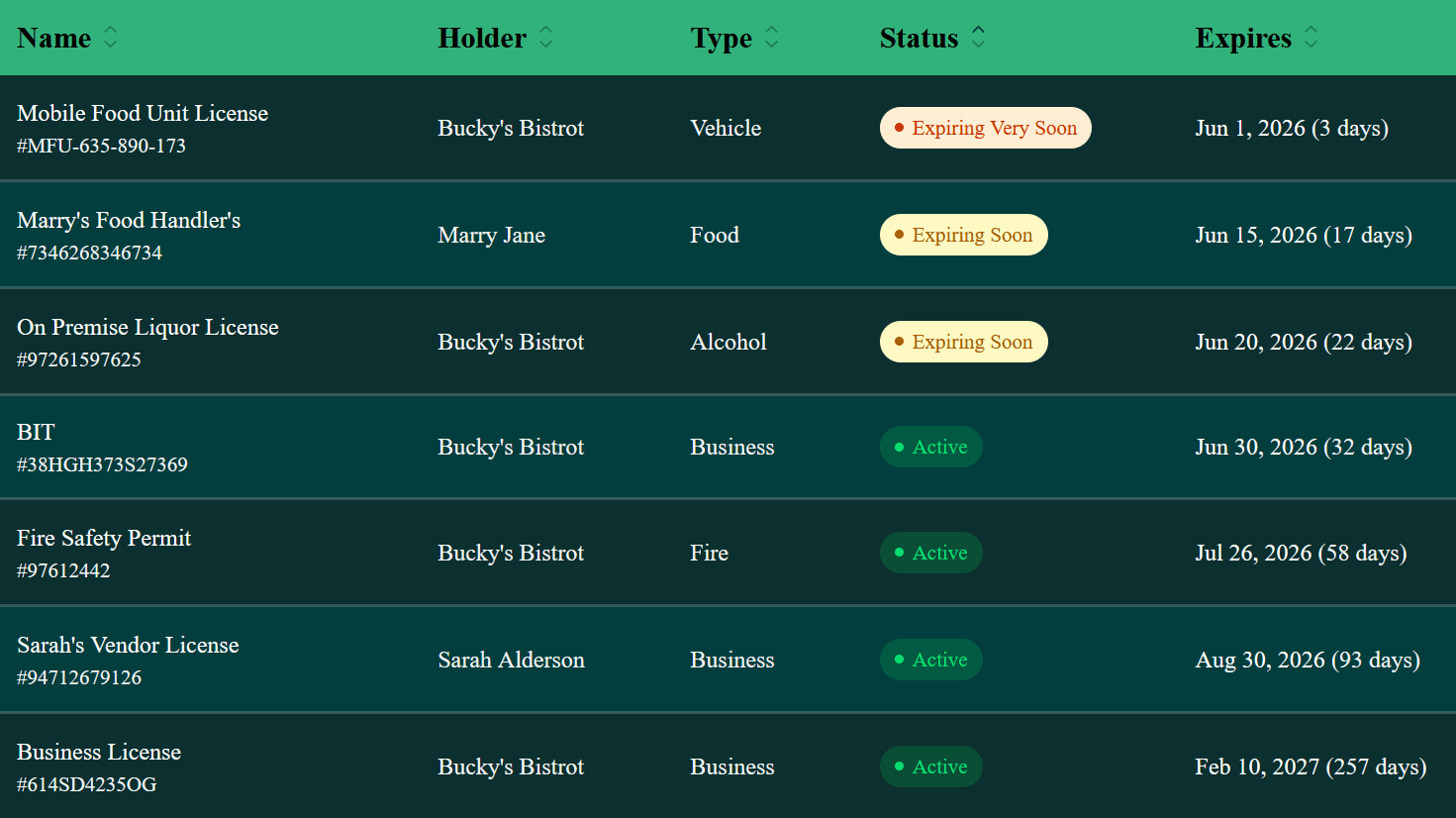
Every TFE, every COI rider, every certification. Sorted by what expires next.
The county TFE permits, the city street vendor permit, the state cottage food registration, the processed food registration, the scale cert, the commissary kitchen lease, the Process Authority Letter for the salsa, and every helper's food handler card all live in one table. Status badges flag what is current, expiring soon, or past due. Sort by expiration and the next renewal is always at the top, no matter which jurisdiction it sits under or which market it covers.
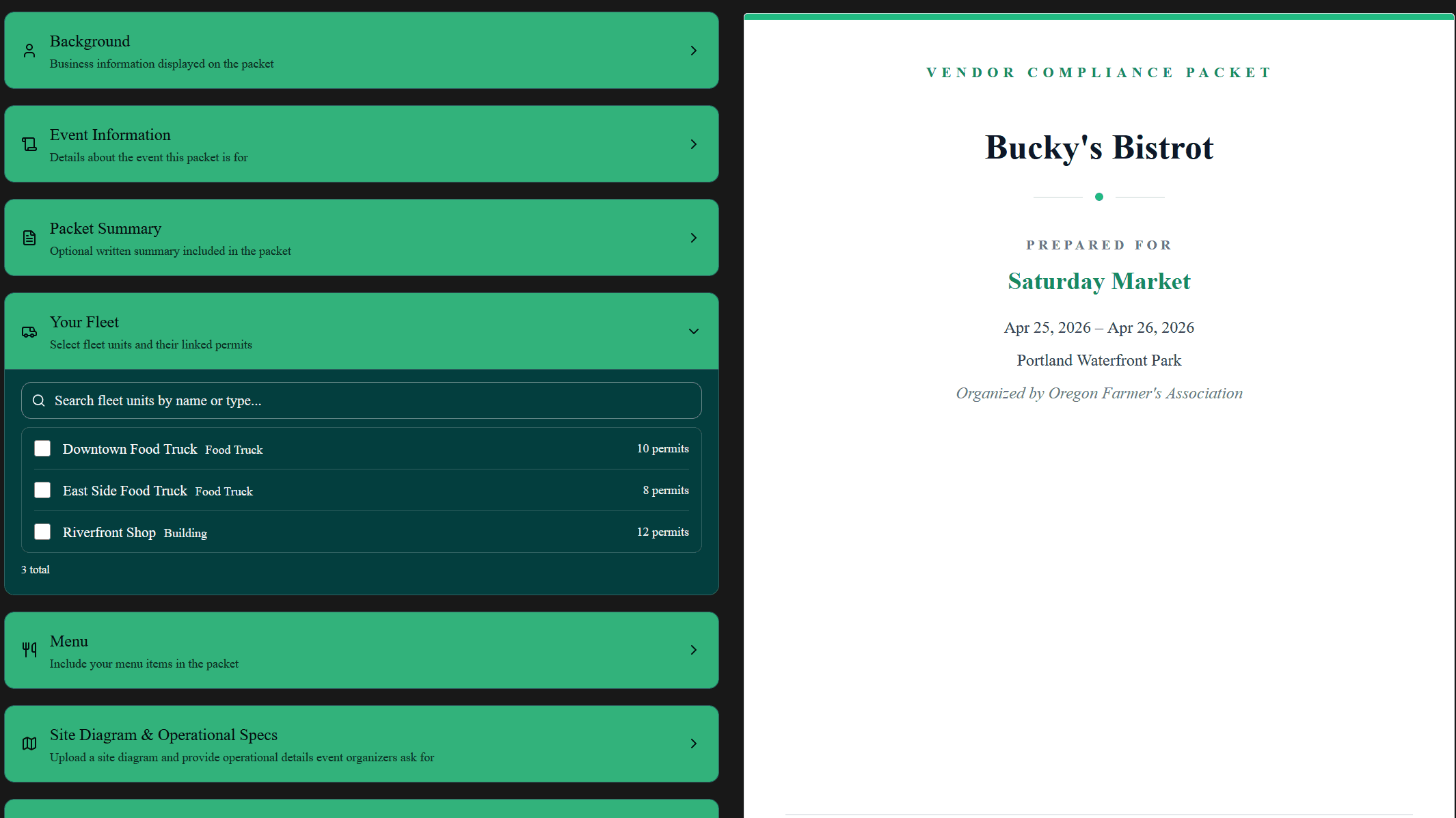
The new-market application packet, generated in one screen.
A new market opened applications and they want a vendor application with a market-specific COI rider, a current TFE for the host county, the commissary kitchen lease, and food handler cards for everyone on the booth. Open the event, pick the booth setup, attach the COI rider with the market auto-listed as additional insured, select the staff working it with their current certifications, hit generate. The packet downloads as a single branded PDF ready to email to the market manager before the application deadline.
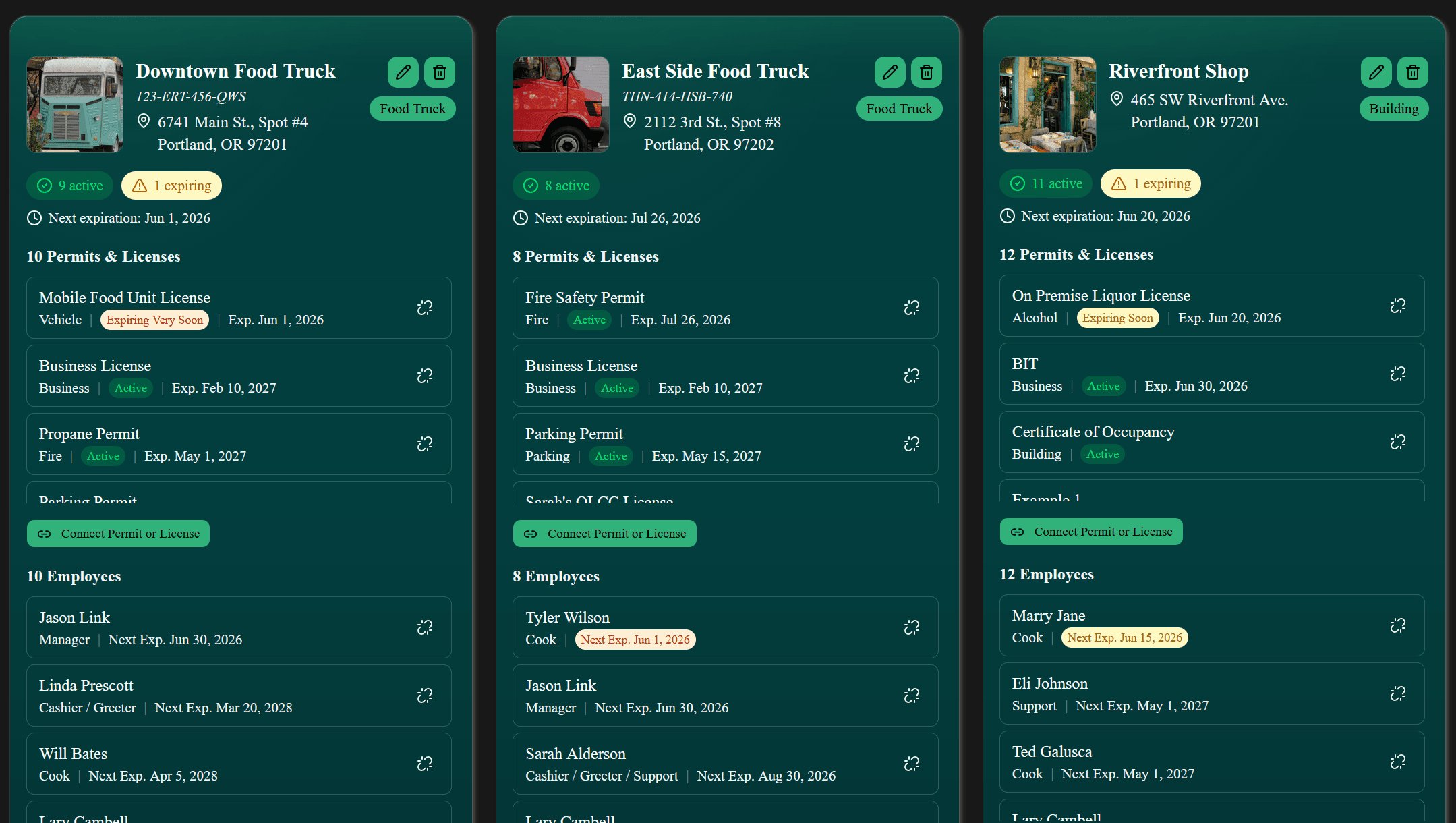
One card per market, per pop-up, per commissary.
Each market the booth works lives on a card with its address, its market organization, the active TFE permit covering that county, the COI rider for that specific market, the day and time the booth sets up, and the staff assigned. The Saturday market downtown, the Sunday market across the river, the Wednesday office park pop-up, the six-week holiday market all live side by side. When a market manager asks at the gate which permit covers the booth today, every document is on one card.
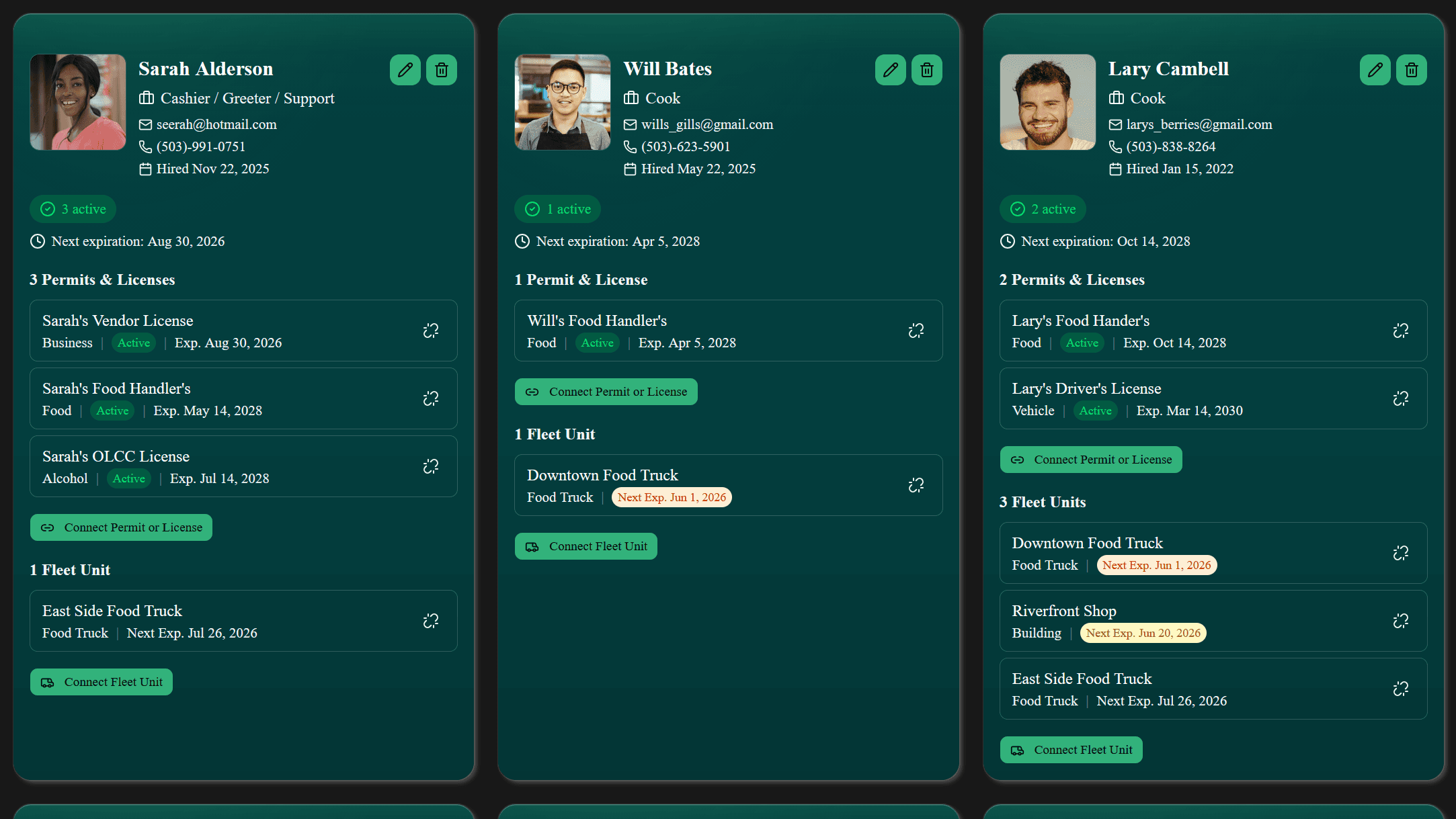
A card for every helper on the booth.
Each helper gets a card with their state food handler card, their PIC certification if they cover the booth alone, and any state-specific allergen training. Assign each helper to the markets they actually work. When the Saturday helper's food handler card expires three weeks before peach season hits, the card flags it before the county inspector does. The 19-year-old at the booth is never the reason a citation gets written.
A Saturday in July
A real Saturday for a vendor with eight regular markets.
It is 4:45am and the cargo van is loaded. Coolers are stacked two-deep behind the front seats. The 6am setup is at the downtown market in one county. The 11am setup is at a smaller neighborhood market across the river in a different county. The Sunday market in a third county is on tomorrow's schedule. The new helper hired in May is meeting at the downtown market for her second shift.
The TFE for the downtown county was filed in February. It is current. The TFE for the neighborhood market across the river expires this coming Wednesday. The renewal portal opens four weeks out and the booth missed the email last month. The new helper's food handler card was current when she was hired in May. It expired nine days ago and she did not mention it.
In CredentiAlert, the neighborhood TFE renewal is flagged sixty days out as Expiring Soon with the portal login saved against the record. The new helper's food handler card shows up red on the personnel card with the state's renewal link. The owner gets the digest Thursday morning at the commissary, refiles the TFE from her phone while waiting for the dough hooks, and sends the helper the renewal link before the Saturday shift starts. The downtown setup happens at 6am. The cross-river setup happens at 11am. Nothing about Saturday changes.
The same two renewals, caught Saturday morning at the gate instead of Thursday morning at the commissary, are the van going home with a full inventory and the helper being sent home from her second shift.
The lowest prices on the market
Comparable platforms charge $43 to $59 per month and only offer 14-day trials. CredentiAlert starts free, forever, and the full-featured Pro plan is under $10.
Select Annual to save ~17%
Looking for unlimited* usage or a custom plan? Contact CredentiAlert at contact@credentialert.com to set up an Enterprise plan that works best for you.
*Unlimited tiers are subject to our Fair Use Policy to prevent spam and abuse.
Frequently asked
What multi-market vendors want to know.
Do I need a permit to sell food at a farmers market?
In almost every US jurisdiction, yes. Most cities and counties require a Temporary Food Establishment (TFE) permit issued by the local health department for each booth selling prepared, processed, or non-pre-packaged food. The exact name varies (TFE, Temporary Event Permit, Mobile Food Vendor Permit, Direct Marketing Permit), and the issuing authority is usually the county environmental health division, not the state and not the market itself. Cottage food vendors selling only specific shelf-stable items under their state's cottage food law may be exempt from the TFE but typically still need cottage food registration and the right product labeling.
Does my TFE permit cover multiple markets in different counties?
Usually not. A TFE permit is issued by a specific city or county health department and only covers events held inside that jurisdiction. A vendor working a Saturday market in one county and a Sunday market in the next county typically needs two separate TFE permits with two separate inspection schedules and two separate renewal dates. Some states do offer a statewide mobile food vendor permit, but coverage and reciprocity vary widely. The clean assumption is that each new county means a new permit.
What is a Process Authority Letter and which products need one?
A Process Authority Letter (PAL) is a formal scientific evaluation of an acidified food recipe by a certified Process Authority, typically a university food science department or a private firm. It is required by the FDA for any low-acid food (vegetables, peppers, fruit) made shelf-stable by added acid (vinegar, lime juice, citric acid) below pH 4.6. That covers most hot sauces, salsas, pickles, chutneys, relishes, jams, and many chutney-style condiments. The PAL costs roughly $70 to $150 per recipe, and the vendor also needs Better Process Control School certification and FDA registration with a Food Canning Establishment (FCE) number. Most home and market vendors selling acidified foods do not realize they need any of it until an inspector asks.
How does a Certificate of Insurance work at a farmers market?
Most markets require vendors to carry general liability insurance with the market organization and often the city or property owner listed by name as additional insured on a per-market rider. A generic insurance certificate is not enough. The vendor's insurer issues a separate endorsement for each market that lists that market organization specifically, and the COI document the vendor submits to the market manager must show that endorsement. Some markets verify the COI at annual application time. Others verify it every booth setup. Lapsed coverage or a missing rider is grounds for application rejection or on-the-spot removal from the market.
Can I sell cottage food across state lines?
In almost every state, no. Cottage food laws are explicitly intrastate. The vendor can sell only inside the state that issued the cottage food registration, and only through approved channels (typically direct sales at farmers markets, farm stands, and from the home, but not retail wholesale and not online shipping). Vendors who advertise on Instagram and ship a jar to a friend in another state are violating their home state's cottage food law and the destination state's food sales rules at the same time. State agriculture departments routinely send cease-and-desist letters after spotting interstate shipments on social media.
What permits do I need for a sidewalk pop-up or street fair?
Sidewalk pop-ups and street fairs typically require a city street vendor permit or a special event permit issued by the city, not a county TFE. A vendor with a current county TFE for farmers markets does not automatically have the right to sell on a city sidewalk or at a street fair. The city's permit usually has its own application window, its own fee, and its own list of locations where the vendor is allowed to set up. Operating a sidewalk booth on a county TFE alone is the kind of thing code enforcement writes citations for.
What happens if I'm caught selling at a market without a current TFE?
Consequences vary by jurisdiction but commonly include immediate removal from the market by the market manager, a citation from the county environmental health inspector, an administrative fine often calculated as a multiple of the permit fee, and on-site condemnation of any unapproved food. Los Angeles County administrative fines for unpermitted Compact Mobile Food Operations run up to three times the cost of the permit, plus disposal of every item on the booth. Thurston County, Washington shuts down vendors that operate even one day past the seasonal date range on their TFE. The fine is usually the cheapest part. The lost market day and the lost trust with the market manager cost more.
How is CredentiAlert different from market-management software like Manage My Market or Hivey?
Manage My Market, Hivey, and similar tools are built for the market organization, not the vendor. They track which vendors have uploaded what document into a single market's portal, run vendor applications, and handle market-day check-in. They do not track the vendor's permits and certifications across the other markets the vendor works, the per-market COI riders, the Process Authority Letters for acidified products, or the state cottage food registration that ties everything together. CredentiAlert sits with the vendor and tracks the vendor's entire portfolio of credentials across every market, every county, and every off-site pop-up. The two systems are complementary.
Credential Guides
Not sure which permits your booth needs?
Every permit, license, and registration a market vendor needs, which shifts with what you sell and which county you work, broken down by state and city. Each one shows who issues it, what it costs, and how often it renews, straight from official government sources.