

Bakeries
You opened a bakery to bake.
Not to manage multiple sets of permits.
CredentiAlert holds every permit, license, FDA registration, food handler card, PIC certification, and farmers market TFE in one place. Retail, wholesale, weddings, off-site events. Alerts go out before any of it expires, so the morning the inspector arrives is just another Tuesday.
No credit card required to get started.
The PIC coverage rule
A → B
One shift without a current Certified Food Protection Manager on the floor.
Most state health codes require a CFPM-certified Person in Charge on duty every operating hour. A single shift without one on the floor is what drops an A to a B in most inspection scoring systems, and the letter grade goes in the front window. Five years of word-of-mouth, undone by an expiration date nobody was watching.
Every customer who pulled you into a new revenue stream pulled you into a new permit.
The retail counter was the easy part. One health permit, one PIC card on the wall, an annual inspection from the county. Then the coffee shop down the street asked for a wholesale account, and the county retail permit turned into a county retail permit plus a state wholesale food processor license, with a separate inspector and a separate renewal date. Then the regular running the Saturday market asked you to bring a booth, and the booth turned into a temporary food establishment permit from a different county health department. Then a bride asked for a wedding cake at a winery venue, and the venue asked for a certificate of insurance with their name listed as additional insured, due 48 hours before the event.
Every one of those revenue streams is real money. Every one came with its own paperwork, its own inspector, and its own renewal calendar that has nothing to do with the others. The county retail permit renews in March. The state wholesale processor license renews in October. Each farmers market vendor permit renews on the anniversary of the booth's first weekend. The federal FDA Food Facility Registration only renews in Q4 of even-numbered years, and the next window is the same three months as the holiday pie rush.
In Oklahoma, a home baker who crosses the $20,000 Home Baking Act cap without securing commercial permitting first is facing a misdemeanor and fines, not a warning letter. Most states draw a line like it somewhere. The crossing is the trip wire.
The POS catches the sale. Square, Toast, Lightspeed all know which loaves moved this morning. None of them know whether the wholesale processor license that lets the bakery sell to the coffee shop is current. None of them know whether the head baker's CFPM card lapses next week. None of them know that the venue needs a COI on file by Thursday for the Saturday wedding. The production software like BakeSmart and Cybake handles recipe scaling and ingredient costing. It does not handle the day the market manager turns the van away because the TFE permit expired Wednesday.
The fix is not another POS, not another bakery ERP, not another spreadsheet on a tab labeled “Renewals.” The fix is one dashboard that ties the county retail permit to the state wholesale license to every farmers market TFE to the federal FDA registration to every employee's ServSafe and allergen card, and warns the owner before any of it goes red. CredentiAlert is what bakeries have been running on whiteboards, Google Calendar alarms, and the binder in the back office.
The layer your POS and your bakery ERP both skip.
Square rings up the sale. BakeSmart scales the recipe. CredentiAlert keeps the licenses behind both of them current.
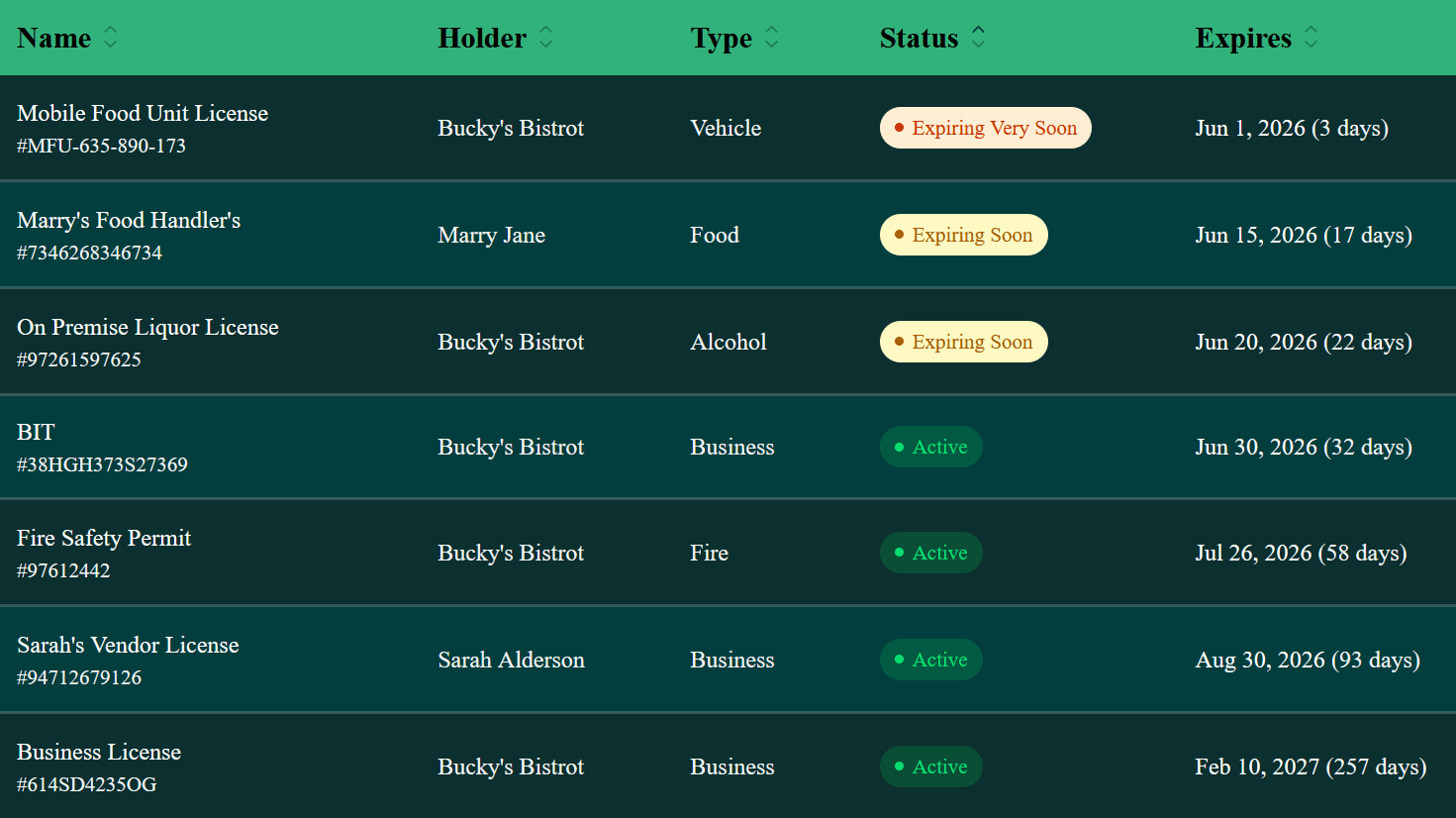
Federal, state, county, market. Sorted by what expires next.
The FDA Food Facility Registration, the state wholesale food processor license, the county retail health permit, every farmers market TFE, every employee ServSafe card, and every PIC certification all live in one table. Status badges flag what is current, expiring soon, or past due. Sort by expiration and the next renewal sits at the top, no matter which jurisdiction it sits under or which oven it covers.
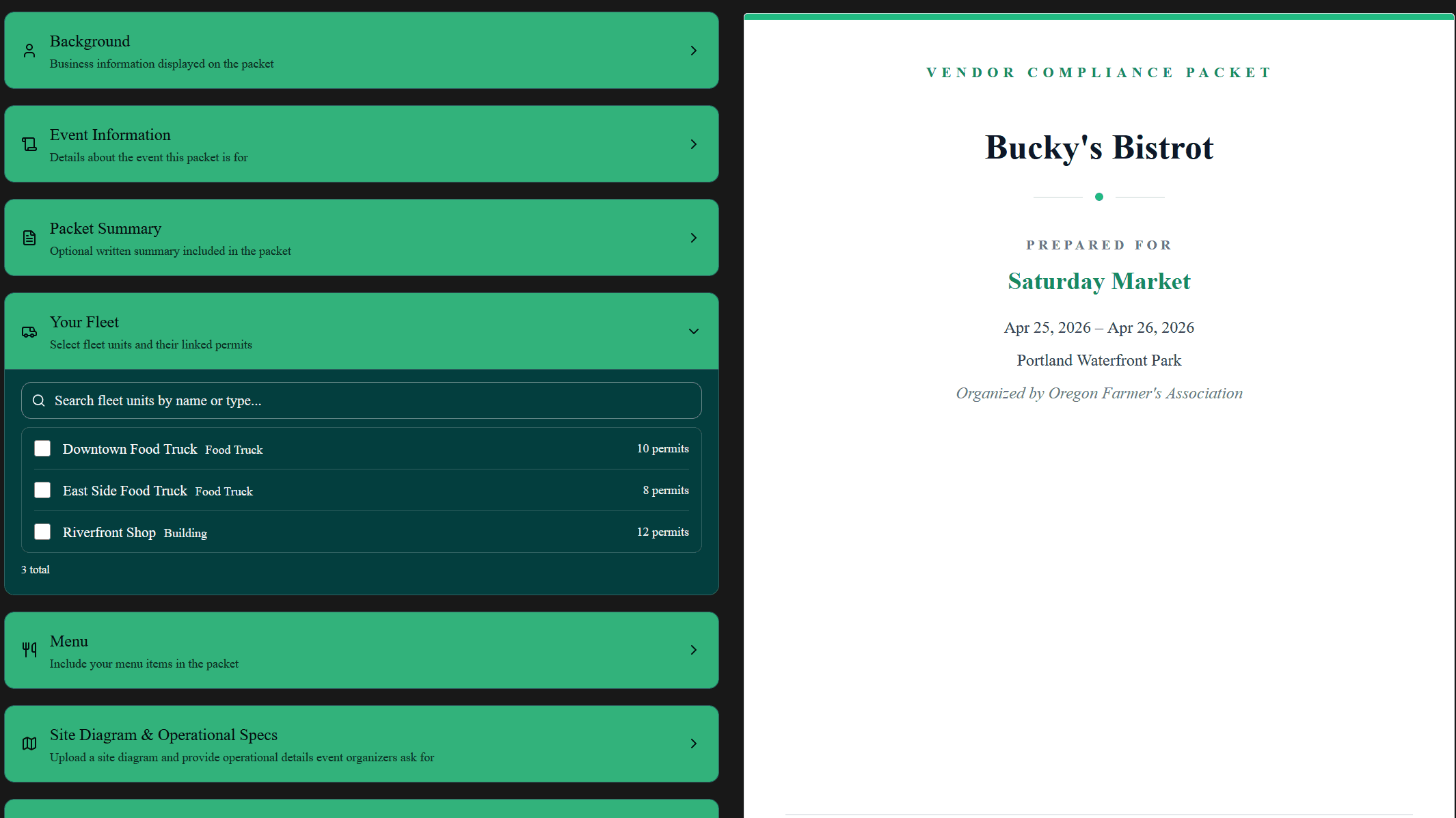
The wedding venue COI, generated in one screen.
A winery is hosting the Saturday wedding cake delivery. The country club venue needs a certificate of insurance with their name as additional insured, by Thursday end of business. Open the event, pick the bakery location, attach the COI from the document vault with the venue auto-listed, select the staff delivering with their current food handler cards, hit generate. The packet downloads as a single branded PDF ready to email to the wedding coordinator.
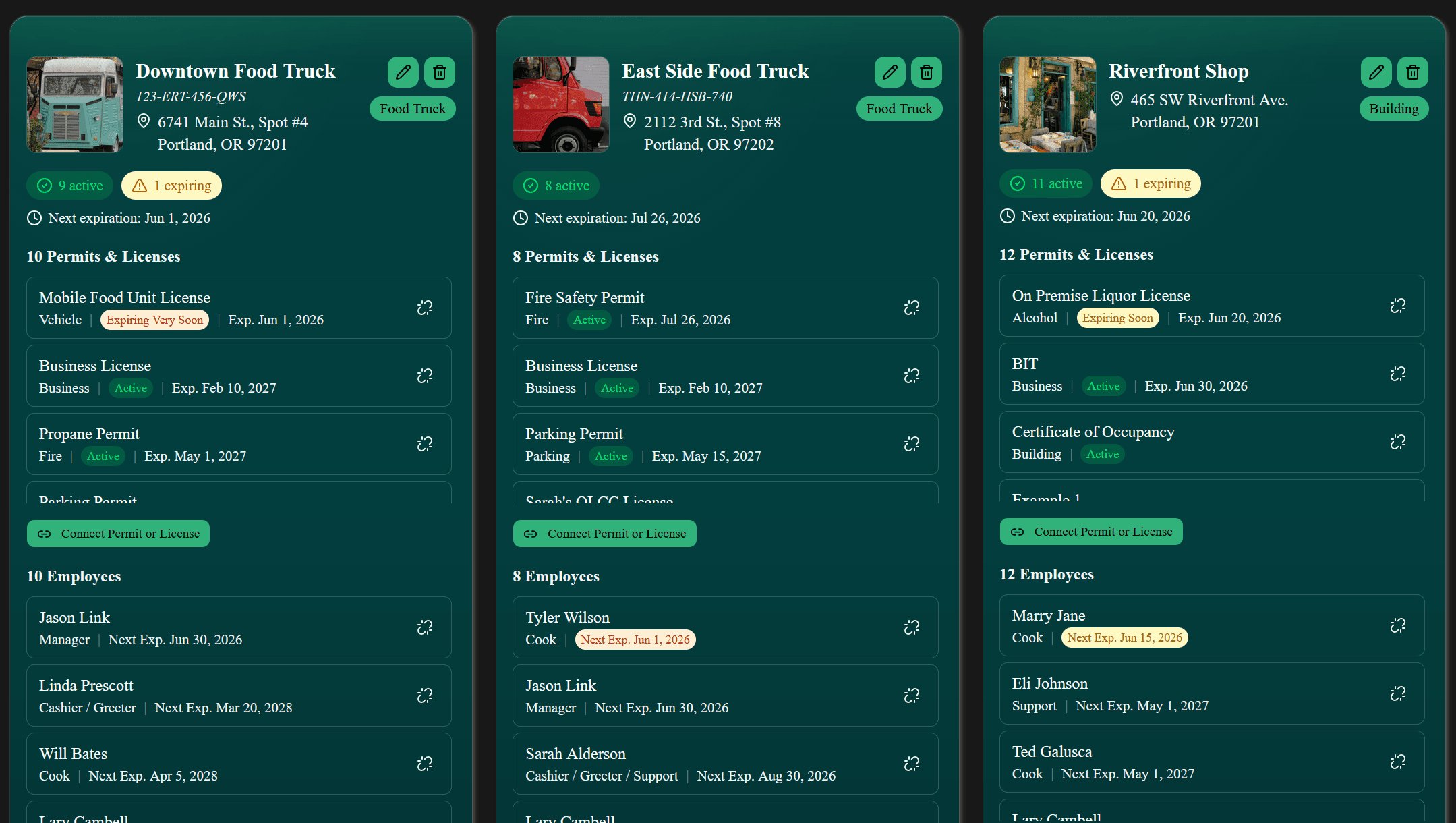
One card per shop, commissary, and market booth.
Each location lives on a card with its address, its assigned bakers, its retail health permit, and the local TFE or wholesale licenses attached. The Main Street shop, the rented commissary on the east side, the Saturday farmers market booth, the weekend market across the river all live side by side. When the wholesale account audits the vendor file, every license they ask for is on one card.
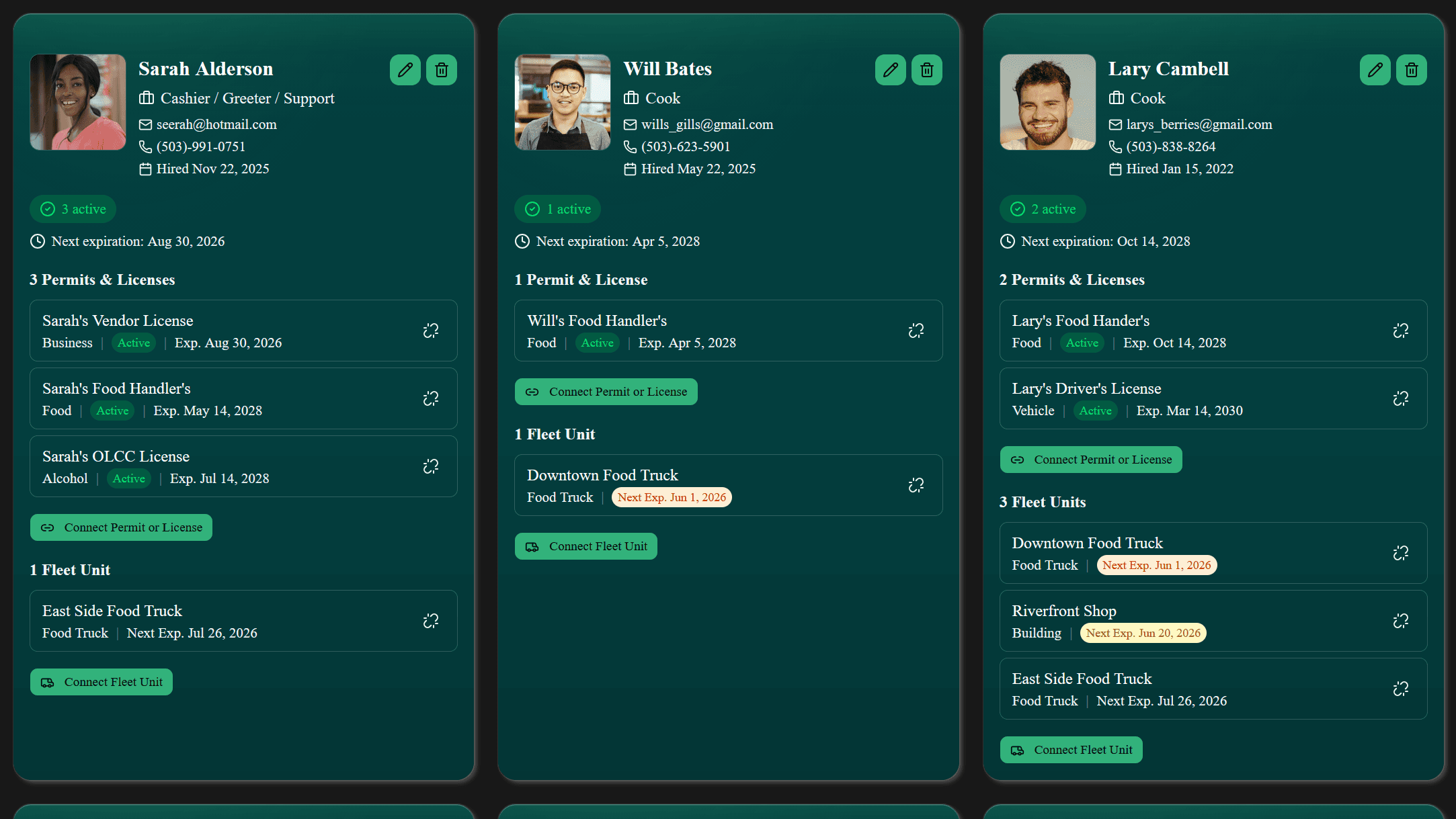
A card for every baker, decorator, and counter lead.
Each staff member gets a card with their state food handler card, their CFPM certification if they cover shifts as PIC, their allergen awareness training if the state requires it (Illinois ASA, Michigan), and any wholesale-delivery driver credentials. Assign each baker to the shifts and locations they actually work. When the head decorator's ServSafe expires three weeks before the wedding rush, the card flags it before the health inspector does.
A Friday afternoon in October
What it looks like to run retail, wholesale, and a market booth in the same week.
It is Friday at four. The wholesale order for the three cafe accounts is staged on the rack by the back door. The Saturday market van is loaded with proofing baskets for a 5am bake. The wedding cake for Sunday is in the walk-in. The newest baker, hired six weeks ago, is closing the retail counter alone for the first time.
The owner is upstairs at the laminator. She is not thinking about the farmers market vendor permit that the city renewed eleven months ago. She is not thinking about the FDA Food Facility Registration window that opens October 1 of every even year. She is not thinking about the newest baker's ServSafe card, which was current when she was hired but which expires in nine days.
In CredentiAlert, the farmers market TFE permit is flagged sixty days out as Expiring Soon. The FDA registration is flagged in the September dashboard digest with the Q4 even-year window highlighted. The new baker's ServSafe expiration shows up on the personnel card with a red badge and the renewal portal link saved against her record. The owner gets one email Friday morning. The renewal goes in by phone during the laminator's proofing window. Nothing about the Saturday market changes. Nothing about the Sunday wedding changes. Nothing about the wholesale delivery changes.
The same renewal, caught Saturday morning at the market instead of Friday afternoon at the laminator, is the van going home with four hundred pastries and the regulars finding out the booth is closed.
The lowest prices on the market
Comparable platforms charge $43 to $59 per month and only offer 14-day trials. CredentiAlert starts free, forever, and the full-featured Pro plan is under $10.
Select Annual to save ~17%
Looking for unlimited* usage or a custom plan? Contact CredentiAlert at contact@credentialert.com to set up an Enterprise plan that works best for you.
*Unlimited tiers are subject to our Fair Use Policy to prevent spam and abuse.
Frequently asked
What multi-stream bakers want to know.
What licenses do you need to start a bakery?
It depends on where you bake and how you sell, but most bakeries need a business registration, a state bakery or food establishment license, and a food handler card before they open. A home baker can often start under a state cottage food exemption with no license at all, as long as sales stay under a state cap and the goods are shelf-stable. Selling wholesale to stores adds a state wholesale license and FDA Food Facility Registration, and a farmers market booth needs a temporary food permit for each market. The exact list, fees, and agencies vary by state and city, so check your state guide for the specifics and confirm against the official sources. The moment you add a second sales channel, the number of licenses and renewal dates climbs fast, and that growing pile is what CredentiAlert keeps in one place.
What permits does a bakery need to sell baked goods wholesale to another business?
Selling baked goods business-to-business almost always requires more than a retail food permit. Most states issue a separate Wholesale Food Processor license (the exact name varies, sometimes Manufactured Food License, sometimes Food Processing Plant License) issued by the state department of agriculture or department of health. The wholesale facility gets its own inspection on a different schedule than the retail counter. If the wholesale account ships product across state lines, FDA Food Facility Registration is also required at the federal level. Cafes and grocers increasingly audit their vendor files, and a lapsed wholesale license is grounds for an account to drop the bakery as a supplier.
How often does a bakery need to renew FDA Food Facility Registration?
Under the Food Safety Modernization Act, the FDA requires every facility that manufactures, processes, packs, or holds food for US consumption to register with the FDA, and the registration must be renewed in Q4 of every even-numbered year. The renewal window only opens October 1 and closes December 31. The next window after 2026 is October 1 to December 31, 2028. Missing the window means the registration goes inactive, and operating without it carries federal civil penalties on top of any state-level enforcement.
Do farmers market booths each require a separate vendor permit?
In most jurisdictions, yes. A Temporary Food Establishment (TFE) permit is issued by the city or county health department where the market is held, not by the state, and not by the market itself. A bakery selling at three different markets in three different cities will typically carry three separate TFE permits, each with its own renewal cadence and its own inspector. Some markets require the permit be posted at the booth during operating hours, and the market manager has authority to refuse setup if the permit is expired or missing.
Does every shift need a Certified Food Protection Manager on duty?
Most state health codes require a Certified Food Protection Manager (CFPM) on duty during all operating hours, which means the bakery must have enough certified staff to cover every shift the doors are open, including weekends and early mornings. A single shift without a current CFPM card on the floor is a critical violation in most inspection scoring systems, and critical violations drop the letter grade displayed in the front window. CFPM certifications (the most common is ServSafe) are typically valid for five years and require renewal through an accredited program.
When does a cottage food bakery need to become a licensed retail bakery?
Cottage food laws vary state by state, but most set either a sales cap (Oklahoma at $20,000 gross annually, California at $150,000) or a venue restriction (no shipping, no sales to retailers, no farmers market wholesale). Crossing any of those lines without first securing commercial permitting is the trip wire. In some states it is a misdemeanor with fines, in others a cease-and-desist letter, but in all of them it permanently complicates the transition to a fully licensed retail bakery. The clean path is to apply for the retail food establishment permit, the state wholesale license if selling B2B, and any local business licenses before crossing the cottage food line.
Is allergen awareness training required for bakery employees?
It depends on the state. Illinois requires every restaurant and food establishment to have at least one Allergen-Safe Adult (ASA) certified employee per shift. Michigan requires similar allergen awareness training for food handlers. Most other states do not mandate it, but most product liability insurers ask whether bakery staff carry allergen training, and a documented allergen program is a near-requirement for any wholesale account selling into schools or healthcare facilities. Tracking which staff have current allergen certifications is what separates a bakery that can take a wholesale account from one that gets passed over.
What insurance does a bakery need to deliver wedding cakes to off-site venues?
Most wedding venues require a Certificate of Insurance (COI) from any food vendor working the event, listing the venue as additional insured for the date of the event. General liability is the baseline. Product liability is often required separately, especially given allergen exposure risk. Commercial auto insurance covers the delivery van. The COI is typically requested 48 to 72 hours before the event, and venues will refuse delivery without it on file. Bakeries doing more than a handful of weddings a year benefit from a standing relationship with their insurer to turn around venue-specific COIs same-day.
What is the difference between a bakery POS like Square and a compliance tracking system?
A POS handles transactions, employee clock-ins, inventory counts, and basic sales reporting. Square, Toast, Lightspeed, and the bakery-specific platforms like BakeSmart and Cybake all operate at the transaction and production layer. None of them track when the FDA registration is due to renew, whether the head baker's ServSafe card is still current, whether the city TFE permit for the Saturday market expires next week, or whether the wedding venue has a current COI on file. CredentiAlert tracks the licensing and credential layer that sits underneath the POS, alerts on every upcoming expiration, and stores every document in one place. The two systems are complementary.
Credential Guides
Not sure which licenses your bakery needs?
Whether you are just starting out, selling from a home kitchen, or opening a storefront, see every permit, license, and certification a bakery needs, from the cottage food rules and state bakery license down to local permits, broken down by state and city. Each one shows who issues it, what it costs, and how often it renews, drawn from official government sources you can check yourself.