

Bars
The state is tracking your compliance.
Are you?
CredentiAlert tracks every liquor license, server certification,and building permit across every bar in your business and reminds you well before anything expires, so a forgotten date never turns into a padlocked door. Built for local food and beverage businesses with dozens to hundreds of legal credentials to track.
No credit card required to get started.
What one missed renewal costs a bar
32 days
Standard liquor license suspension for one uncertified bartender.
In January 2024, the Oregon Liquor and Cannabis Commission proposed a 32-day suspension and a $4,950 civil penalty against a bar where one employee had been serving alcohol without a valid service permit. With a zero day grace period, the bar was dark the day the suspension landed. For a neighborhood bar pulling thirty grand a week, a month-long shutdown is an extinction-level event. The certification costs twenty-six dollars. The lapse costs a month.
Liquor licenses don't disappear. They quietly expire.
Most bar licenses are not lost to bad operators. They are lost to turnover.
When the cocktail lounge opens its second location, the state registration is tied to the GM at the flagship. Eighteen months later, that GM quits. The renewal notice arrives in a deactivated inbox. The state assumes you received it. The deadline passes in silence. The first time the owner finds out is when a beverage distributor pulls up the morning delivery, queries the state database, and refuses to unload the truck.
In Texas, the only defense against serving a minor is the Safe Harbor rule. It protects the owner if every employee holds a current TABC certification. If a bartender's TABC expires Tuesday and they serve a minor Wednesday, the defense is voided in full.
Then there is the credential matrix. A multi-state group is tracking TABC in Texas, RBS in California, MAST in Washington, OLCC service permits in Oregon, and BASSET in Illinois. Each one has its own renewal cadence, its own issuing agency, and its own online portal. ServSafe Manager for the kitchen. Food handler cards for anyone touching a plate. Annual liquor license renewals at the state. Sidewalk permits at the city. Insurance certificates with the dram shop carrier. A four-bar group is tracking somewhere between fifty and eighty active credentials at any given time.
The hospitality platforms big enough to handle this are built for chains like BJ's and Yard House. The platforms small enough to afford run thin on the credential side. CredentiAlert sits in the middle, built for the operator running two bars who wants the systems of fifty without paying for them.
The four screens that replace the binder.
Here is what a real multi-location bar tracker looks like.
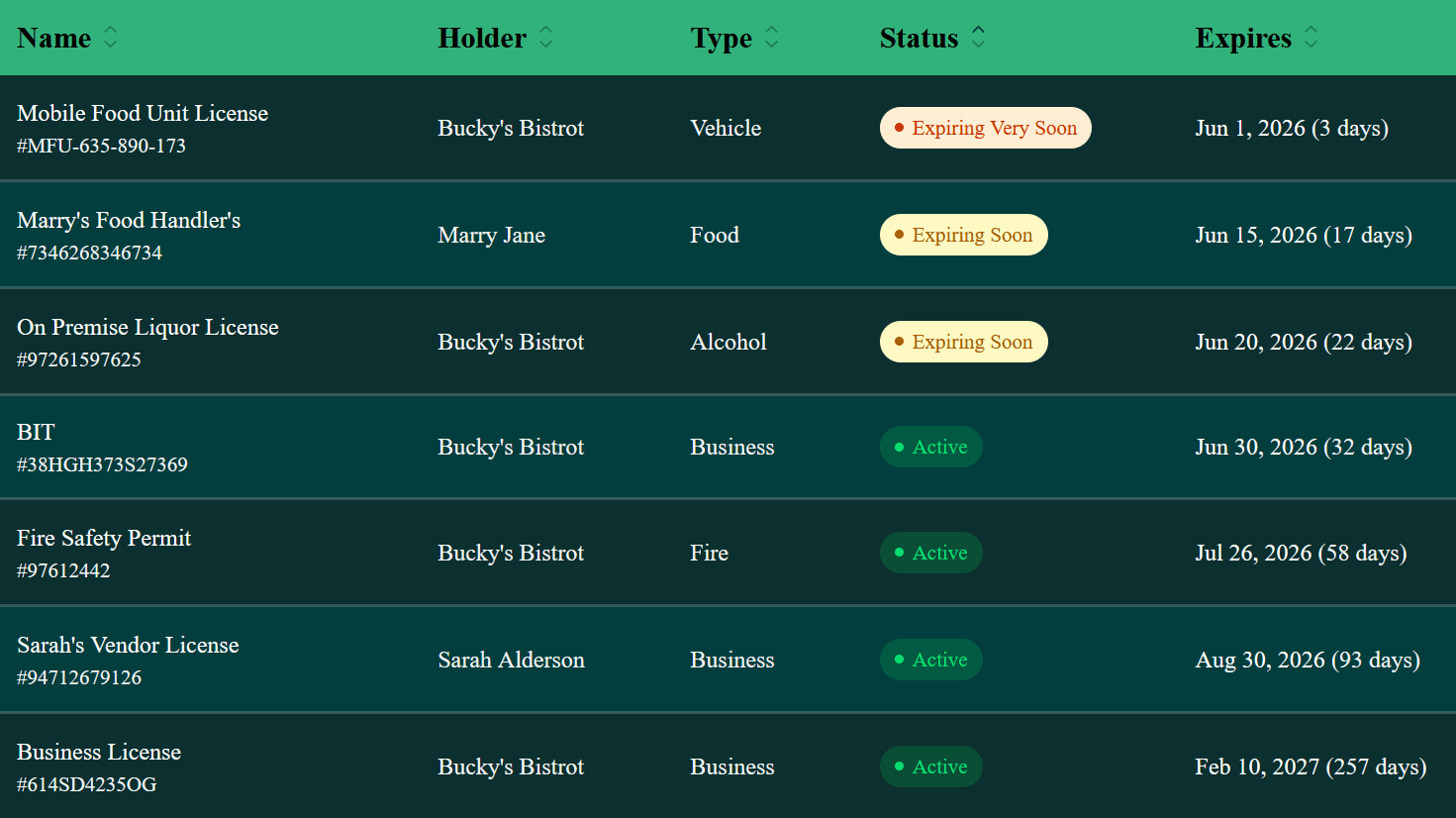
Sort by expiration. The next renewal is row one.
Every liquor license, health permit, occupancy certificate, and sidewalk permit your group carries lives in one table. Status badges flag what is current, expiring soon, or already past due. Each row shows the holder (the bar that carries it), the issuing agency, the permit number, and how many days are left. Click the column header once and the bar walking closest to a dark night sits at the top.
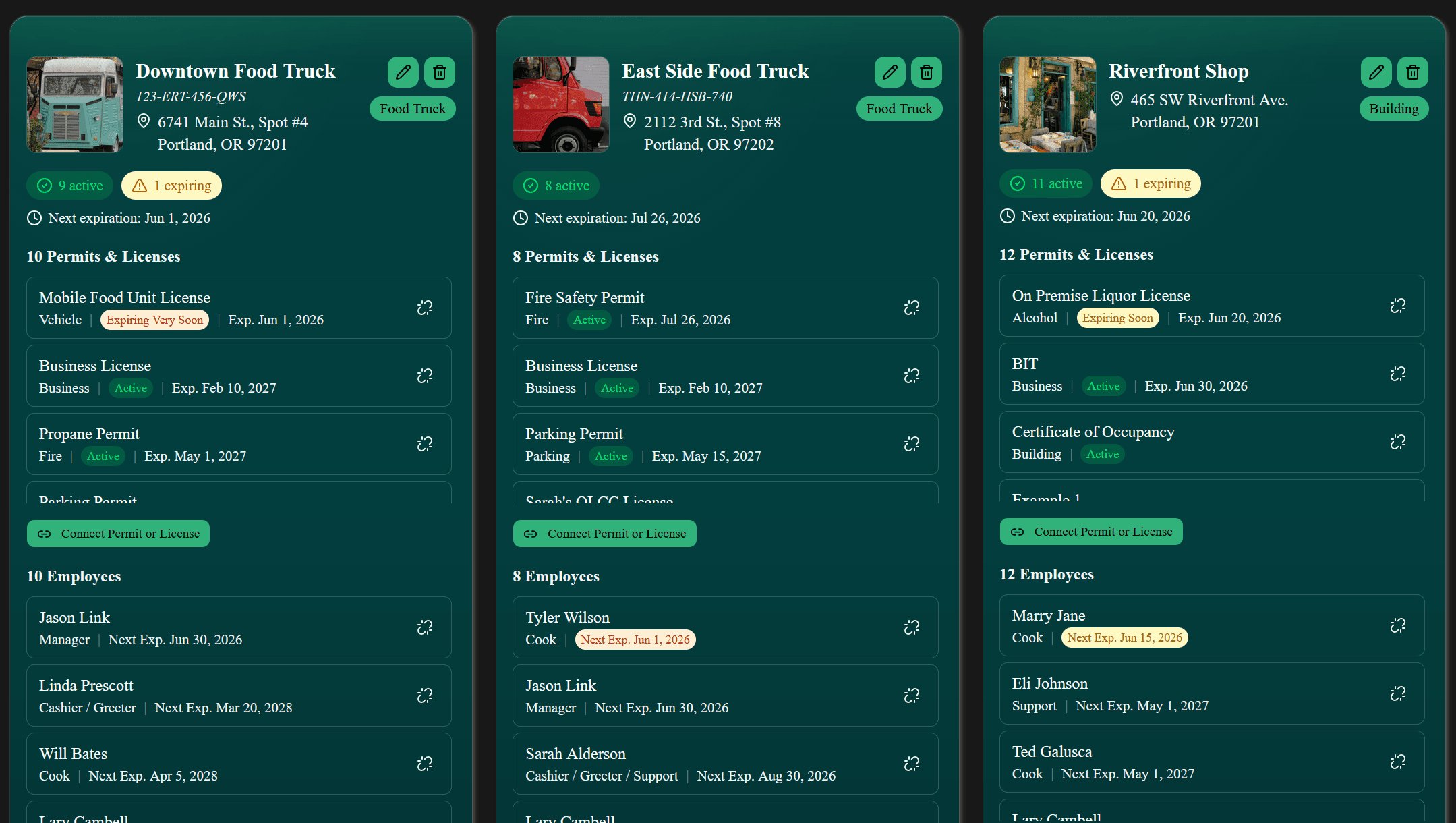
One bar per card. The whole group on one screen.
Each bar lives on a card with its address, its assigned bartenders, and the permits attached to that specific location. Adding a third bar is one click, not another binder. The card view tells you at a glance which location is healthy and which one is about to lose its license.
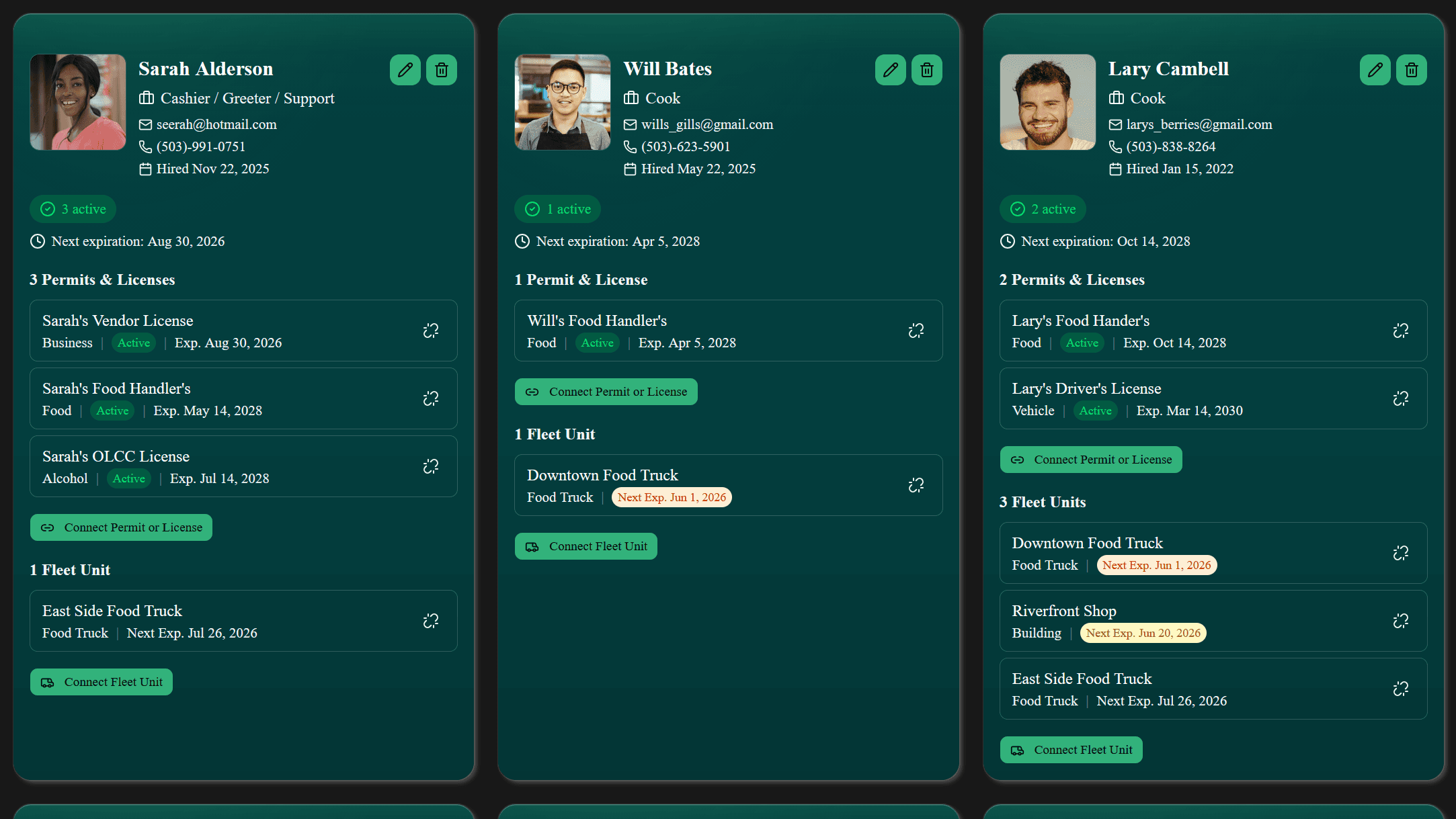
Cards for bartenders, not photocopies in a folder.
Each bartender, server, and manager gets a card with their TABC, RBS, MAST, OLCC, BASSET, or ServSafe credentials and the bars they actually work. When one cert is two weeks out from expiring, the card flags it before the next ABC sting walks in and voids your Safe Harbor.
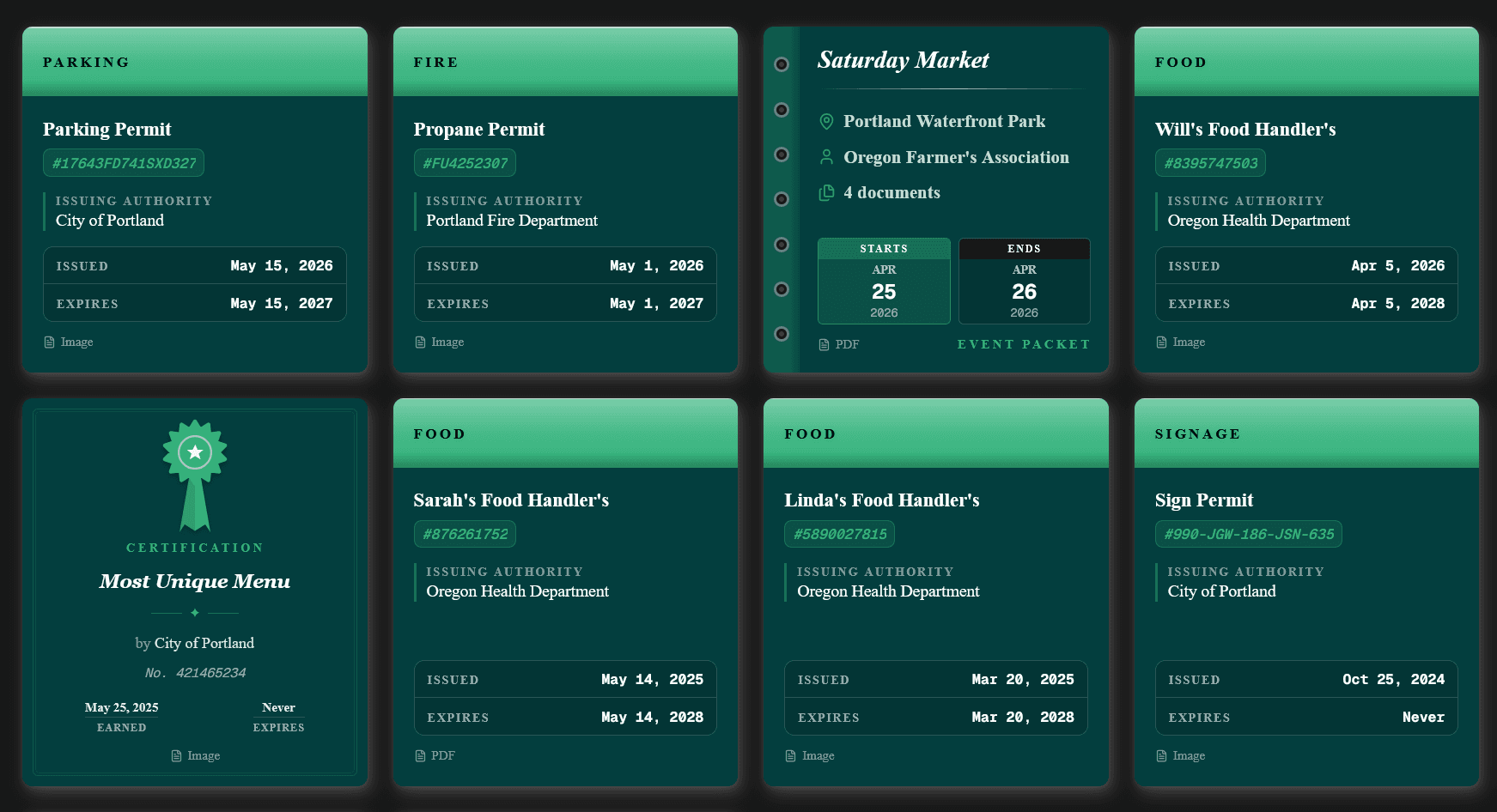
Pull any permit in two clicks.
Every license, certificate of insurance, and inspection report you upload lands in the vault. Search by bar, by bartender, or by document type, and the PDF is on screen. When an event venue needs a current liquor license and dram shop COI on a Thursday afternoon, you find both before the email reply box loses focus.
A Tuesday at the bar
The keg truck pulls up. The state says you're inactive.
The driver scans the state liquor database from the cab before he opens the trailer. Your license shows expired six days ago. The renewal notice was mailed to the GM who quit in March. He forwarded one batch of mail and then forgot. The state assumed you received it. You did not.
He cannot legally unload. The kegs go back to the warehouse, and you are dry until the state reactivates the license. Three days if you are lucky. Three weeks if you are not. Either way, the bar loses a weekend.
In CredentiAlert, the renewal reminder hit the owner's inbox sixty days out, then thirty, then fourteen, then seven. Not the former GM's inbox. The owner's. The renewal was filed in week one. The truck shows up Tuesday morning, the database says active, the kegs come off the truck, and the dinner shift opens with a full draft list.
Renewal reminders should not depend on which GM still has their email.
The lowest prices on the market
Comparable platforms charge $43 to $59 per month and only offer 14-day trials. CredentiAlert starts free, forever, and the full-featured Pro plan is under $10.
Select Annual to save ~17%
Looking for unlimited* usage or a custom plan? Contact CredentiAlert at contact@credentialert.com to set up an Enterprise plan that works best for you.
*Unlimited tiers are subject to our Fair Use Policy to prevent spam and abuse.
Frequently asked
The questions we hear from bar operators.
What happens if a bar liquor license expires?
In most states, an expired liquor license means the bar must stop serving alcohol immediately. Beverage distributors query the state database before every delivery and will refuse to drop kegs or cases if the license is inactive. Operators can usually file a late renewal, but the bar must be dark until the state reactivates the license. Repeat lapses can trigger a full hearing or non-renewal. CredentiAlert emails the owner at sixty, thirty, fourteen, and seven days before expiration, then again one and seven days after if the renewal is still outstanding.
How long is a TABC certification valid in Texas?
TABC seller-server certifications are valid for two years from the date of issue. Every employee who sells, serves, or delivers alcohol must hold a current TABC certification for the bar to claim Safe Harbor protection in a sale-to-minor case. If even one bartender is uncertified at the time of the violation, the defense is voided and the license can be canceled. CredentiAlert tracks every bartender, every certification, and every renewal date in one dashboard.
Can a bar operate while waiting for a liquor license renewal?
It depends on the state. Some states (like Texas and Oregon) grant a grace period if the renewal application was filed before the expiration date. Others (like California) require the application to be approved before service can continue. The safest practice is to file thirty to sixty days early and never assume a grace period applies. CredentiAlert alerts the operator sixty days before expiration so renewal is well underway before the deadline.
Do bar managers need to be ServSafe certified?
In most jurisdictions, yes. If the bar serves any food (even bar bites or shareables), at least one ServSafe Manager or equivalent food protection manager must be on-site during all operating hours. The certification is valid for five years. Multi-location bar groups often need multiple certified managers per location to cover all shifts. CredentiAlert tracks each manager certification and which bars they cover.
What is the difference between TIPS, ServSafe Alcohol, RBS, MAST, and TABC?
They are different alcohol server training programs. TIPS and ServSafe Alcohol are generic industry-standard programs accepted by many states. State-specific programs include TABC (Texas), RBS (California), MAST (Washington), OLCC service permits (Oregon), and BASSET (Illinois). Each state requires its own approved program, has its own renewal cadence, and is enforced by its own liquor authority. Multi-state operators need to track all of them. CredentiAlert flags the correct program for the correct location.
What is Safe Harbor protection for bars?
Safe Harbor is a legal defense available in some states (most notably Texas) that protects a bar from license cancellation when an employee serves a minor, provided the bar has met certain training and supervision requirements. In Texas, every employee involved in alcohol service must hold a current TABC certification at the time of the violation. If even one employee is uncertified, the defense is voided. Safe Harbor is the single most important reason to keep server credentials current.
Who is liable if an uncertified bartender serves a minor?
The bar, the licensee, and often the bartender personally. State liquor authorities can fine the bar, suspend or cancel the liquor license, and pursue civil penalties. Plaintiff attorneys in dram shop cases look first at whether the serving employee was properly certified at the time. An expired certification can pierce the liquor liability insurance policy entirely, leaving the owner exposed to a personal-asset judgment. CredentiAlert tracks every bartender certification by location and flags any lapse before it becomes a liability.
How do multi-location bars manage compliance across different states?
Most run a spreadsheet per state, a binder per location, and rely on each GM to remember the renewal cycle until something gets missed. The cost of the system that prevents a lapse is a fraction of the cost of the lapse itself. CredentiAlert Pro costs less per year than a single day of lost revenue from a suspended liquor license. CredentiAlert consolidates every bar into one dashboard with state-aware tracking. If California requires RBS and Texas requires TABC, the system flags the correct credential for the correct bartender at the correct location. The dashboard rolls up the full compliance status of the entire bar group.