

Food trucks
Permits change by city.
Keep every truck open & on the street.
CredentiAlert tracks every permit, license, and certification across every truck, every city, and every employee. We'll let you know when it's time to renew. Perfect for multi-location truck and trailer operators managing dozens to hundreds of permits. Scan a permit once and forget about it until it is time to renew.
No credit card required to get started.
The cost of one missed renewal
$18,000
What a five-truck operator can lose in a single missed renewal cycle.
Los Angeles County charges up to three times your permit fee as an administrative fine when you operate without a current health permit. Compound that across a fleet and one bad month gets expensive fast, and that is before you count the revenue lost from being shut down.
When your trucks cross county lines, know you're good to go.
The pain is not the permit. The pain is what happens to the permit when you go from one truck to five.
David Sevcik runs ten food trucks in Colorado. In testimony before a state legislative committee, he explained that keeping up with fire department permits alone means tracking around sixty different jurisdictions in the state, each with its own reciprocity rules.
“I have to know where does the county line end?”
Manuel Betancourt runs sixteen trucks in Austin. Until the city changed its rules in 2025, every one of his trucks had to be physically driven to a city facility in North Austin for its annual health inspection. Sixteen trucks. Sixteen lost service days, every year, for an inspection process the rest of the world had figured out how to digitize a decade ago.
Most permit trackers were built for restaurants and bolted onto food trucks afterward. They assume your location stays put. They assume your Certified Food Manager works one address. They do not understand that a fleet can cross three counties in a single week, or that event organizers want a current packet for the specific truck arriving on the specific day.
So operators do what operators do. They build the spreadsheet. They color-code the renewal dates. They snap a photo of each permit and hope the album does not fail them at the next inspection. CredentiAlert is what the operators we talked to were already trying to build for themselves.
Every truck. Every city. Every permit.
Here is what a real fleet tracker looks like.
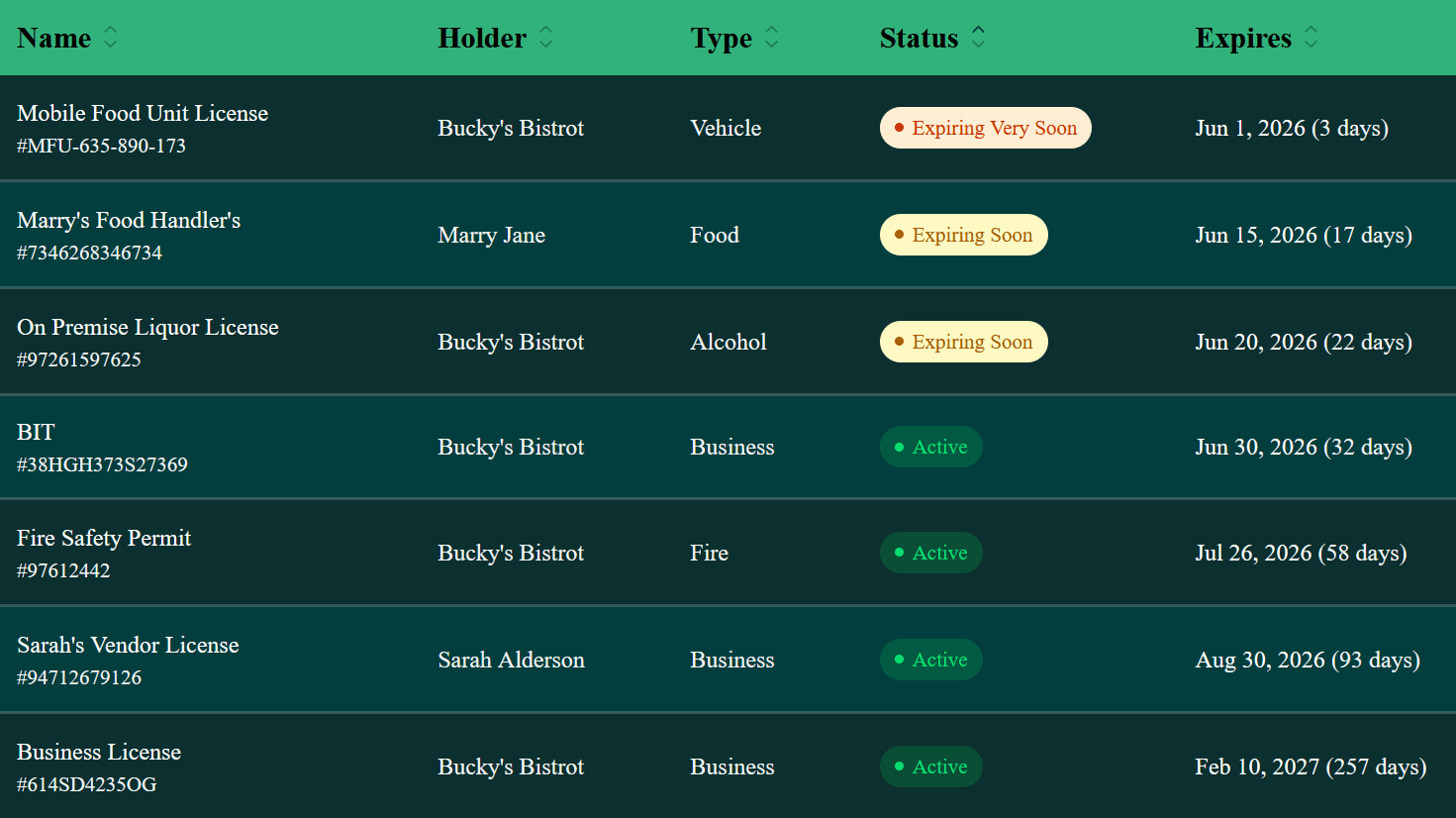
Every permit. Every license. Sorted by what expires next.
All your permits and licenses live in one searchable, sortable list. Color-coded status badges flag what is expiring very soon, expiring soon, or still active. Each row shows the holder (the truck or employee that carries it), the issuing agency, and how many days are left. Sort by expiration and the next thing to renew sits right at the top.
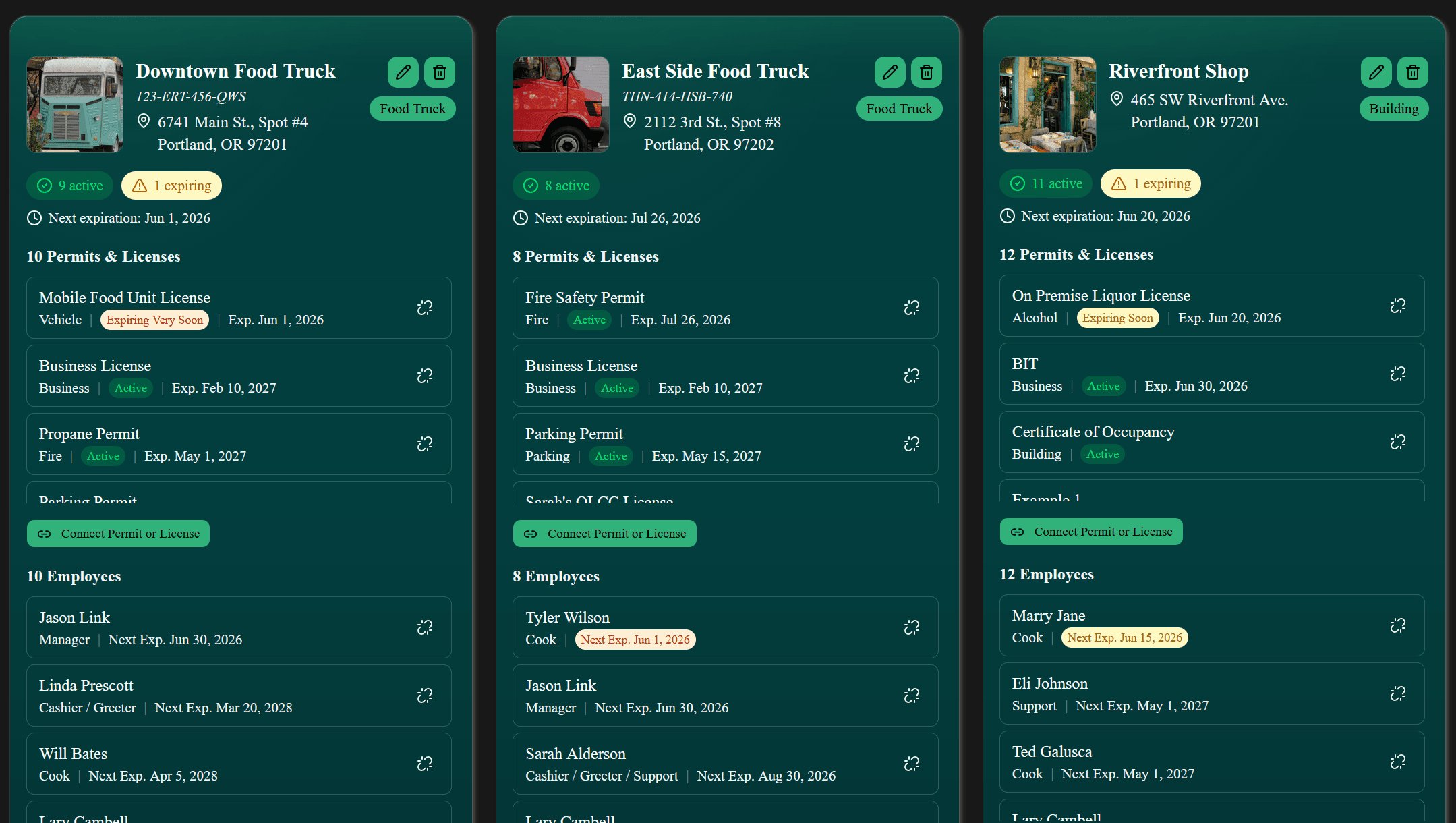
Your fleet on one page, not seven tabs.
Every truck lives on the same screen with its current operating status, its assigned employees, and its active credentials. Adding a sixth truck does not mean opening a sixth spreadsheet. It means clicking Add Unit and getting back to the window.
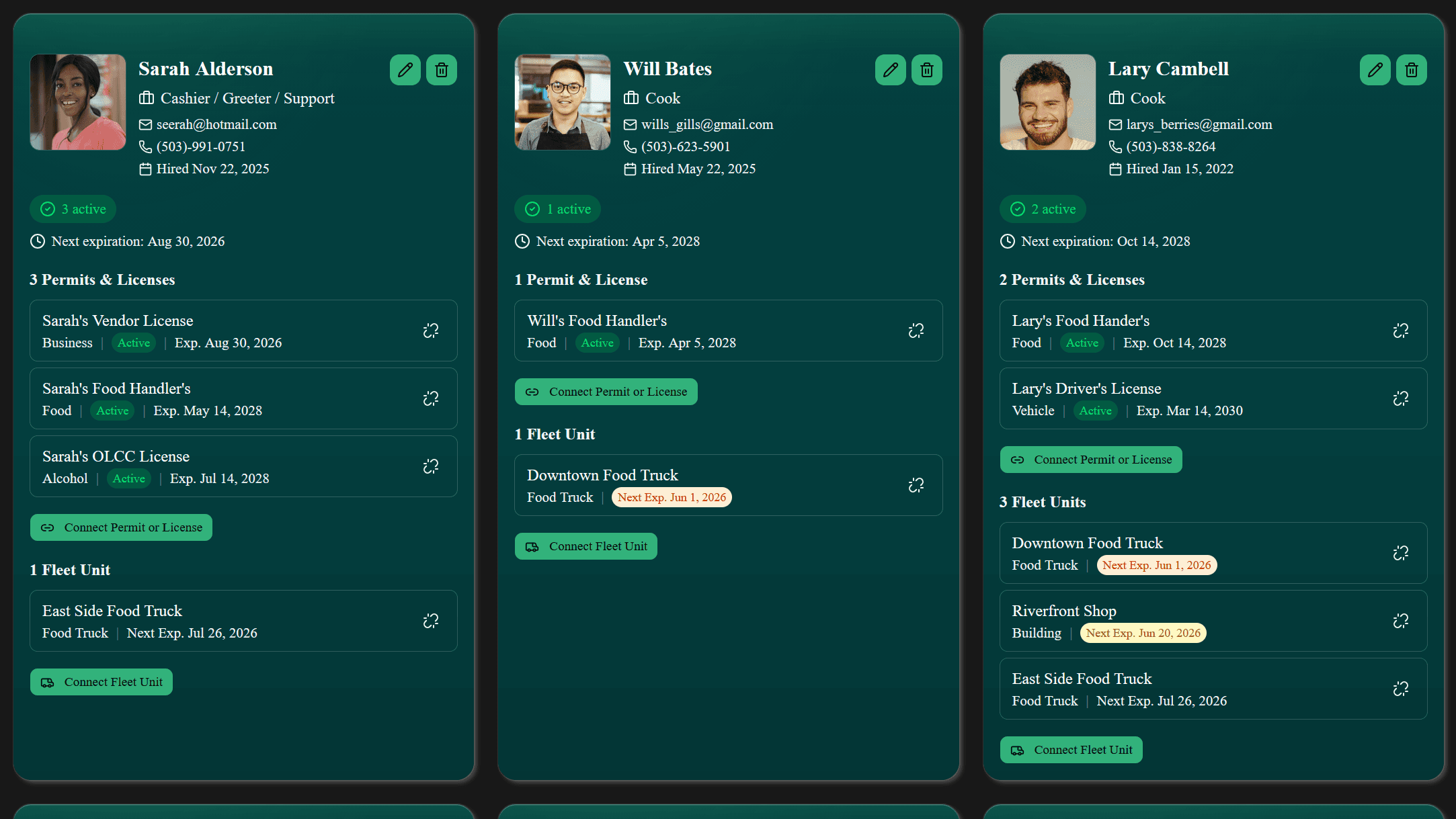
Every employee. Every credential. Every truck they can work.
Each employee gets a card with their food handler, their ServSafe Manager certification, and any other credential you track. Assign them to the trucks they actually work, and the dashboard flags expirations before a sick day or a missed renewal turns into a shutdown.
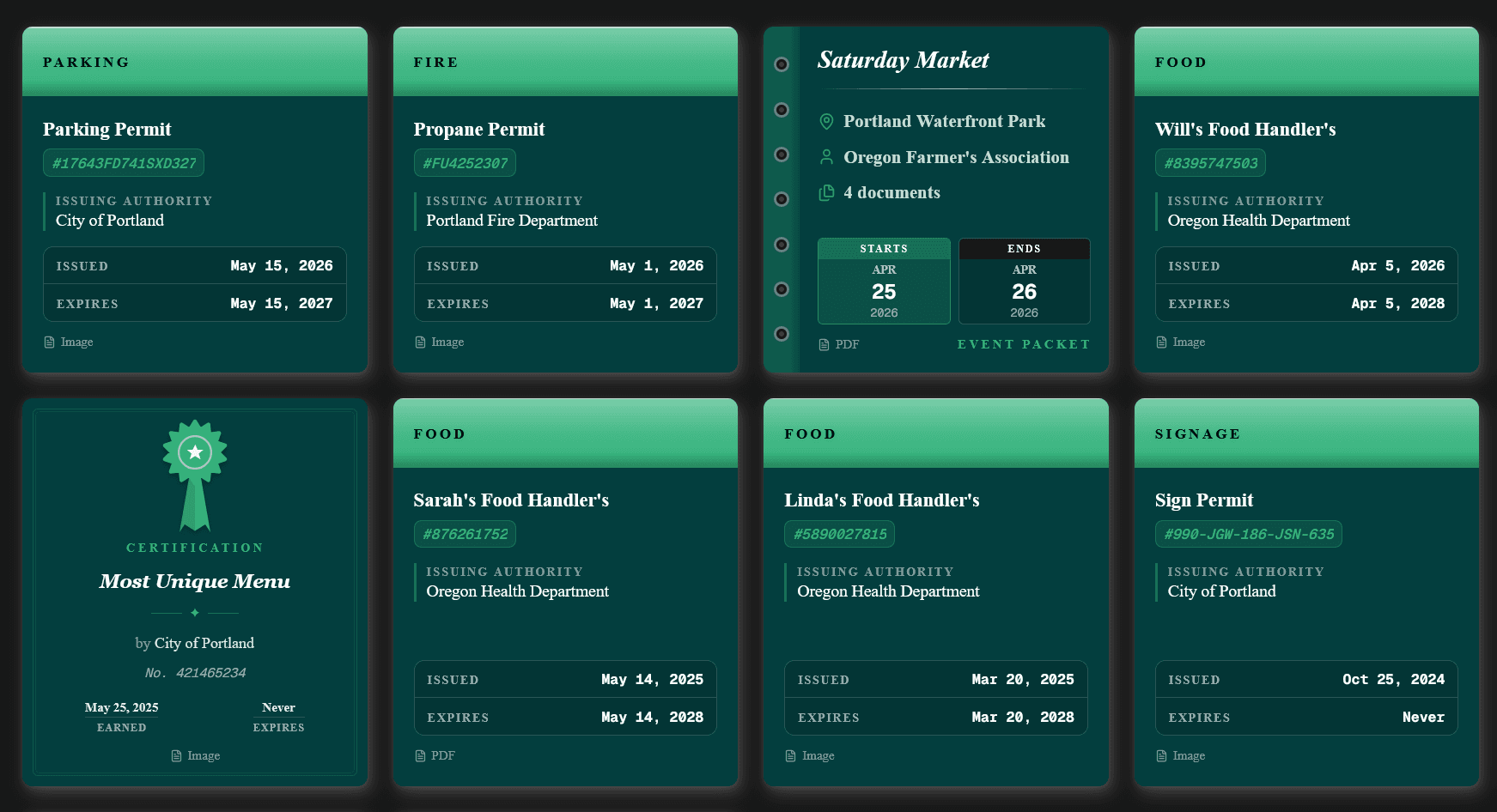
Your paper trail, one search away.
Every permit, license, and certificate you scan or upload lands in the vault. Search by truck, city, or employee, and the document is there to view or download. No more digging through the glove box when an inspector walks up to the window.
A day with three trucks
Friday afternoon. Three events. Two cities. Six minutes.
Truck 2 is heading to Portland Saturday Market. Truck 5 is on a private catering booking out in Hillsboro. Truck 7 is parked at a PSU pop-up. Each organizer wants the same packet by five today: certificate of insurance, current health permit, fire clearance, and the food handler for whoever is working the window.
In CredentiAlert, you open each truck, click Generate Event Packet, add the event name and date, and download the PDF. Three packets, six minutes. The right documents for the right truck on the right day, every time.
Without it, this is the part of the week you start dreading on Wednesday.
The lowest prices on the market
Comparable platforms charge $43 to $59 per month and only offer 14-day trials. CredentiAlert starts free, forever, and the full-featured Pro plan is under $10.
Select Annual to save ~17%
Looking for unlimited* usage or a custom plan? Contact CredentiAlert at contact@credentialert.com to set up an Enterprise plan that works best for you.
*Unlimited tiers are subject to our Fair Use Policy to prevent spam and abuse.
Frequently asked
The questions we hear from food truck operators.
What permits and licenses do I need for a food truck?
It depends on where you operate. Most US food trucks need at minimum a mobile food vendor permit from the local health department, a state business license, a state seller's permit, commercial vehicle registration, general liability insurance, and a food handler certification for every employee. Cities and counties layer on fire permits, zoning approvals, commissary agreements, and event-specific permits. CredentiAlert tracks all of them in one place.
Do I need a separate permit for each food truck I own?
In nearly every US jurisdiction, yes. Each truck is treated as its own mobile food unit and requires its own health permit, its own fire inspection, and its own commercial vehicle registration. If you run five trucks across three counties, that is at minimum five health permits and five separate renewal calendars. Multi-unit operators are exactly who CredentiAlert was built for.
How do I track food truck permits for multiple trucks?
Most operators use spreadsheets, paper binders, or phone photos until that approach stops scaling. CredentiAlert replaces those with a fleet-level dashboard that shows every truck, every permit, every jurisdiction, and every renewal date at a glance. You can filter by city, by truck, or by what is expiring in the next thirty days.
What happens if my food truck permit expires?
You get shut down. Most cities require you to stop operating immediately and reapply for the permit. Many charge administrative fines on top of the standard renewal fee. Los Angeles County, for example, charges up to three times the permit fee per violation. For a multi-unit operator, a single missed renewal cycle can cost tens of thousands of dollars in fines plus the revenue lost while the truck sits idle.
Can I use the same food truck permit in multiple cities?
Usually no. Health permits are issued by the local jurisdiction, which means crossing a city or county line typically requires a separate permit. A handful of states are starting to streamline this. Texas HB 2844, effective July 2026, creates a single statewide mobile food permit. Outside of those exceptions, plan on a permit per city per truck.
Do all my food truck employees need food handler cards?
In nearly every state, yes. Anyone who handles food on the truck needs a current food handler certification. Several states also require a Certified Food Manager to be on-site during all operating hours, which means at least one CFM scheduled per truck per shift. CredentiAlert tracks each employee's certifications and which trucks they are cleared to work.
What is a commissary agreement and do I need one?
A commissary is a licensed commercial kitchen where you prep food, clean equipment, and store ingredients between shifts. Most US jurisdictions require food trucks to have a signed commissary agreement on file. New York City, Chicago, Houston, and most of California enforce this strictly. If you operate trucks across multiple jurisdictions, you may need separate commissary agreements for each.
How does CredentiAlert work for operators with multiple trucks?
Every truck has its own profile with its own permits, inspections, vehicle records, and assigned employees. The fleet dashboard shows the full picture at a glance: which units are compliant, which are about to expire, and which need attention right now. Adding a new truck does not multiply your work. It adds a row.
Credential Guides
Not sure which permits your food truck needs?
Every permit, license, and certification a food truck needs, broken down by state and city. Each one shows the specific details that matter: who issues it, what it costs, and how often it renews, straight from official government sources.